Pan Dehai
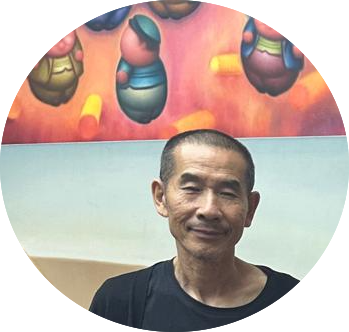
Pan Dehai 潘德海 Born 1956, China Pan Dehai was born in February 1956 in Siping, Jilin Province, China. He graduated in July 1982 from the Oil Painting Department of the Fine Arts Faculty at Northeast Normal University. In 1989, he received an award at the 7th National Art Exhibition of China, marking an important […]
Pan Dehai 潘德海
Born 1956, China
Pan Dehai was born in February 1956 in Siping, Jilin Province, China. He graduated in July 1982 from the Oil Painting Department of the Fine Arts Faculty at Northeast Normal University. In 1989, he received an award at the 7th National Art Exhibition of China, marking an important milestone in his early career.
In 2002, Pan joined the Faculty of Fine Arts at Yunnan Arts University, where he currently serves as a lecturer. Over the decades, he has participated in numerous significant exhibitions both in China and internationally.
Major exhibitions include China Modern Art Exhibition 1988 (1988, Chengdu), Towards Pop Art (1993, Melbourne), Reality, Today and Tomorrow (1996, Beijing), Asian Contemporary Art Exhibition (2000, London), the International Art Expo (2006, Beijing), and his solo exhibition Pan Dehai (2007, Beijing).
Pan Dehai is widely recognized for his distinctive figurative language and his ongoing exploration of contemporary social and cultural themes within Chinese art.


Pan Dehai: Reconstructing the Allegory of “Man” Between the Absurd and the Everyday
Curatorial Essay
The artistic practice of Pan Dehai has consistently revolved around the central motif of the human figure. Yet he moves beyond realist representation, employing abstraction and symbolic transformation to construct a visual language rich in metaphor and allegory. His most iconic body of work, the “Corn Man” series, developed continuously since the 1990s, stands as both a response to social realities and a profound exploration of individual psychological states.
The “Corn Men” are neither literal portraits nor simple cartoons. Suspended between human and plant, they appear with endearingly rounded forms, uniform attire, and vacant expressions. While their visual qualities may seem humorous or playful, beneath the surface lies pointed social critique and humanistic reflection. In Pan’s paintings, these figures appear as if emerging from “red memory,” yet are placed within the landscape of contemporary consumer society, generating an irreconcilable sense of absurdity. This absurdity is not surreal spectacle, but rather a rupture within reality itself—a dual meditation on the disillusionment of ideals and the expansion of material desire in the spirit of the age.
Pan Dehai does not impose overt declarations. Instead, he approaches composition with restraint and quiet sensitivity. His palette is often saturated yet controlled; his compositions disciplined and inward-looking. Beneath the calm surface of his images, however, lies an ongoing interrogation of human nature, history, and social structures.
Entering the twenty-first century, Pan’s practice gradually shifted toward a more “everyday” visual narrative. He began focusing on subtle, seemingly trivial fragments of daily life, allowing minor details to become catalysts for reflection. As he once remarked in an interview, “Life holds no grand events; attending to these small matters is also a way of returning to the origin of art.” This shift does not signal retreat, but rather an internal reorientation—from public discourse toward personal experience, from symbolic systems toward the depth of lived reality.
Pan Dehai’s art resists simple categorization within any single style or movement. His trajectory resembles an ongoing negotiation between the personal and the collective, between memory and the present moment. As he has observed, “Art is not merely the arrangement of images; it is first and foremost a way of seeing the world and confronting oneself.” Along this path, the “Corn Men” have not reached an endpoint. They continue to evolve, narrating allegories that belong unmistakably to our time.